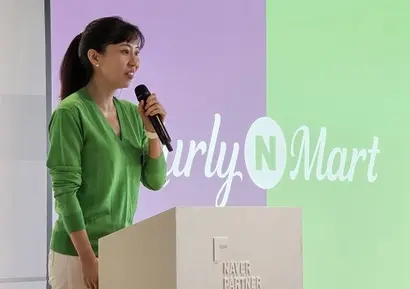
[비즈한국] As Jung Seung-bin, CEO of Next Kitchen and husband of Kurly CEO Sophie Kim, was recently sent to trial on charges of sexually harassing an employee, public criticism toward Kurly is intensifying. Kurly had been enjoying a relatively positive atmosphere, recently recording a quarterly profit. Market analysts had suggested that the company might resume its IPO (Initial Public Offering) efforts. However, the news of CEO Jung's sexual harassment allegations is now casting a negative shadow.

Kurly formalized its listing plans in December 2021 by securing pre-IPO investment. At that time, Anchor Equity Partners invested a total of 250 billion KRW at 100,000 KRW per share. Given that the total number of issued shares was approximately 38 million, Kurly was valued at around 3.8 trillion KRW. Two years later, during the 2023 paid-in capital increase, the new share issuance price was set at 66,148 KRW per share, valuing the company at approximately 2.675 trillion KRW at the time.
As of January 2026, Kurly shares are trading at around 22,000 KRW per share on private stock trading platforms. Based on current market prices, the company’s valuation is roughly 930 billion KRW, a significant decline from the valuation of up to 4 trillion KRW estimated by the investment banking (IB) industry in 2021.
Kurly’s performance is on an upward trajectory. According to business reports, revenue grew from 2.0372 trillion KRW in 2022 to 2.0774 trillion KRW in 2023, and 2.1956 trillion KRW in 2024. Profitability, which had been a point of concern, has also improved. Operating losses of 233.5 billion KRW in 2022, 143.6 billion KRW in 2023, and 18.3 billion KRW in 2024 were followed by a record of 1.7381 trillion KRW in revenue and 9.2 billion KRW in operating profit for the first three quarters of 2025, marking a successful turnaround to profit.
The decline in corporate value despite improved performance is interpreted as a reflection of dampened market expectations. In the early 2020s, expectations for e-commerce companies were high due to the COVID-19 pandemic. However, with the subsequent court receivership filings of numerous e-commerce firms like Wemakeprice, TMON, Brandi, and Interpark Commerce, market sentiment has changed. Wemakeprice and Interpark Commerce eventually filed for bankruptcy. Even SK Group affiliate 11st has failed to sell its business after years of trying due to a lack of interested buyers.
Furthermore, while Kurly's performance has improved, assessments suggest its financial health still has a long way to go. Kurly’s debt-to-equity ratio increased by 107.34 percentage points (p) from 733.63% at the end of 2024 to 840.97% at the end of September 2025. As of the end of September last year, total debt stood at 731.8 billion KRW, while cash and cash equivalents were 220.9 billion KRW. Additionally, by the mid-2020s, Coupang is widely considered to have dominated the e-commerce industry, leading some to argue that there is a limit to the growth of other competitors as long as Coupang remains.
However, as Coupang recently became embroiled in personal data leakage controversies, an opportunity opened for Kurly. As many users declared they would quit Coupang, Kurly emerged as a popular alternative. According to the retail industry, the number of orders on Kurly in December last year increased by approximately 15% compared to the same period the previous year. Considering that Kurly shares were trading in the mid-10,000 KRW range on private platforms last November, the stock price is indeed on the rise. Kurly had previously withdrawn its IPO plan in 2023, but analysts suggested they might resume it given recent positive signals.

Amidst this, public opinion toward Kurly is deteriorating as Jung Seung-bin, CEO of Next Kitchen and husband of CEO Sophie Kim, has been sent to trial for sexual harassment. CEO Jung is accused of sexually harassing a female intern at a restaurant. Given that Kurly has long been known as a woman-friendly company, this sexual harassment incident is expected to cause significant repercussions.
Next Kitchen is a company specializing in Home Meal Replacement (HMR). As a typical B2C firm, it is highly sensitive to public opinion. Kurly holds a 45.23% stake in Next Kitchen, a structure where Next Kitchen's performance can impact Kurly. Next Kitchen generated 17.5 billion KRW in revenue from Kurly in the first three quarters of last year.
As the controversy erupted, Next Kitchen stated in a formal position: "We will conduct a comprehensive audit through an independent external professional organization to determine if the company's measures regarding this matter, including victim protection, were appropriate," adding, "Until the audit is complete, we will suspend the CEO and exclude him from all company business so that he cannot exert any influence."
Controversy remains unresolved, with calls for a boycott of Kurly appearing on social media (SNS). Meanwhile, signs of a rebound from Coupang could also be a source of anxiety for Kurly. Although many users left Coupang at the end of last year due to various controversies, it is reported that its number of active users is currently recovering. If Coupang recovers its former standing, expectations for Kurly are expected to diminish.
If expectations for Kurly decline, an IPO will become more difficult. Considering Anchor Equity Partners' past investment of 100,000 KRW per share, proceeding with an IPO while lowering the corporate value is difficult, as it would be impossible to avoid criticism from investors and shareholders. CEO Sophie Kim holds a 5.71% stake in Kurly. As her shareholding is not overwhelming, she cannot afford to ignore the shareholders' perspective. Regarding the IPO, Kurly stated: "While there is no immediate plan, it is true that we are preparing to go public when market conditions and internal circumstances are favorable."